Key takeaways
- Body mechanics is how you position and move your body during everyday tasks such as sitting, standing, lifting and sleeping.
- Good body mechanics keep your spine close to neutral, keep loads close to your body, use your legs and hips for heavy work and change position often.
- Small changes at a desk, on your feet and in bed can ease strain on your back, neck and shoulders.
- If pain keeps coming back, a physiotherapist, chiropractor, RMT or kinesiologist can look at how you move and build a plan. No referral is needed at Vitality.
Body mechanics is the way you hold and move your body while you sit, stand, lift, reach and sleep. Good body mechanics keep your joints close to a neutral position, keep heavy loads close to your body and let the strong muscles of your legs and hips do the work. Poor habits, such as slouching for hours, twisting while you lift or craning your neck toward a screen, add strain that can build into back, neck and shoulder pain over time.
This guide covers the basic principles, simple changes for sitting, standing, lifting and sleeping, and when it makes sense to have someone look at how you move.
What are body mechanics and why do they matter?
Every task you do loads your muscles, joints and spine in some way. When you work with your body in a balanced position, that load is shared across many structures. When you hold an awkward position for a long time, or lift and twist at the same moment, a small number of tissues take most of the strain.
Common habits that add strain include:
- Slouching in a chair or on the couch
- Pushing your head forward toward a laptop or phone
- Lifting with a rounded back and straight legs
- Twisting your trunk while carrying something heavy
- Bending your wrists up while you type
- Standing or sitting in one position for hours
None of these will injure you on their own. Repeated day after day, they can leave you stiff, sore and more likely to strain something.
What are the basic principles of good body mechanics?
Most advice on body mechanics comes back to a few simple ideas:
- Keep your spine close to neutral. Your back has gentle natural curves. Try not to slump forward or arch far back for long periods.
- Use a wide, stable base. Stand with your feet about shoulder-width apart, or one foot slightly ahead of the other, so you stay balanced.
- Keep the load close. The further an object is from your body, the harder your back has to work to hold it.
- Turn with your feet, not your back. Step or pivot to change direction instead of twisting your trunk.
- Use your strongest muscles. Let your legs and hips do the heavy work so your back does not have to.
- Change position often. Even a good posture becomes tiring if you hold it for hours.
How should I sit at a desk?
Many people spend most of the day sitting, at work, in the car and on the couch. A few adjustments make sitting easier on your back and neck:
- Sit back in your chair so it supports your lower back. A small cushion or rolled towel can help if the chair does not.
- Keep your feet flat on the floor or on a footrest, with your knees at about hip height.
- Relax your shoulders and keep your elbows close to your sides.
- Set the top of your screen at or slightly below eye level, so you are not looking down for hours.
- Keep your wrists straight while you type, rather than bent up or down.
- Get up, walk and stretch regularly. Many people find a reminder every 30 to 60 minutes helpful.
- Rest your eyes from the screen now and then by looking at something in the distance.
A sit-to-stand desk or a supportive chair can help, but changing position regularly matters more than any one piece of equipment.
How should I stand for long periods?
Standing all day, whether at a counter, in a warehouse or on a job site, can be just as tiring as sitting. To ease the strain:
- Stand with your feet about shoulder-width apart, or one foot slightly ahead of the other.
- Keep your knees soft rather than locked.
- Shift your weight and change position often. Resting one foot on a low step or rail can take pressure off your lower back.
- Keep your shoulders relaxed and your chin level.
- Wear supportive footwear, especially on hard floors.
- Bring your work close to you so you are not reaching or leaning forward for long periods.
How do I lift safely?
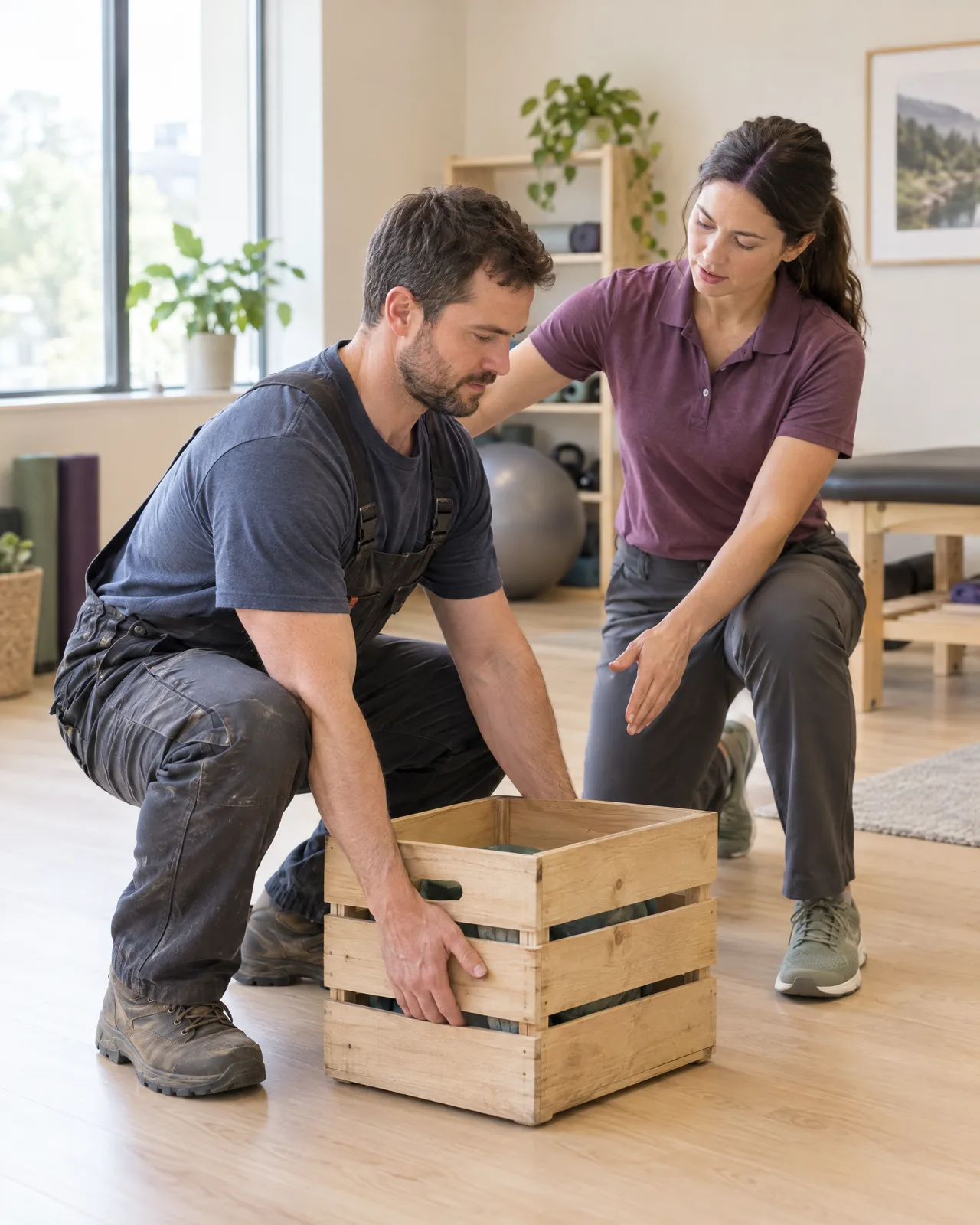
Lifting with poor form is one of the most common ways people strain their back. The aim is to keep the load close and let your legs do the work:
- Plan the lift. Check the weight first and clear your path. If it is too heavy or awkward, get help or use a cart or dolly.
- Get close. Stand close to the object with your feet about shoulder-width apart and one foot slightly ahead.
- Bend your hips and knees. Lower yourself into a squat or half kneel rather than bending over with straight legs.
- Keep your back straight and your head up. Look ahead, not down at the floor.
- Hold the load close. Keep it against your body, between your hips and chest.
- Lift with your legs. Push up through your legs in a smooth movement, without jerking.
- Turn with your feet. Pivot or step to change direction. Do not twist while you hold the load.
- Set it down the same way. Bend your hips and knees again to lower it.
The same ideas apply to lighter, repeated tasks such as unloading groceries, lifting a child or carrying laundry.
Which sleeping positions are easier on your back and neck?
You spend about a third of your life in bed, so your sleeping position matters. There is no single right position, but these ideas help many people wake up with less stiffness:
- Sleep on your back or your side when you can. Lying on your stomach tends to twist your neck and arch your lower back.
- Choose a pillow that keeps your head in line with the rest of your spine, neither propped up high nor dropping down.
- On your side, place a pillow between your knees to keep your hips and lower back level.
- On your back, a pillow under your knees can ease pressure on your lower back.
- Use a mattress that supports you without letting your hips sink far below your shoulders.
- Roll onto your side and push up with your arms to get out of bed, instead of sitting straight up.
What about body mechanics at work?
Desk jobs and physical jobs both have their own strains. At a desk, the main risks are long periods in one position and a head that drifts toward the screen. In physical work, repeated lifting, carrying, bending, reaching and long periods of standing add up over a shift.
Take short breaks to move, and ask your employer about adjusting your workstation or equipment if something keeps causing discomfort. If you are hurt at work in BC, report the injury to your employer and to WorkSafeBC. Our guide to WorkSafeBC physiotherapy explains how care and a graduated return to work are planned around the physical demands of your job.
When should I get help for back or neck pain?
Most everyday aches settle with movement, rest and better habits. Consider booking an assessment if:
- Pain lasts more than a couple of weeks or keeps coming back
- Pain stops you from working, sleeping or doing the things you enjoy
- You are not sure which movements are safe for you
- You want a plan to get stronger and prevent the problem from returning
See your doctor or seek urgent care if back or neck pain follows a fall or accident, comes with numbness, weakness or changes in bladder or bowel control, or is getting steadily worse.
How can Vitality help with posture and body mechanics?
At our two Richmond clinics, several practitioners can help, and they work from one plan when you see more than one of them:
- A physiotherapist assesses how you move, treats the painful area and builds an exercise plan around the movements you need in daily life, such as lifting, reaching and climbing stairs.
- A chiropractor looks at how your joints, muscles and posture work together and treats neck, mid-back and low back pain, including posture problems from desk work.
- A registered massage therapist eases muscle tension, which suits desk workers with tight shoulders and anyone managing overuse.
- A kinesiologist coaches you through progressive training for lifting, carrying, bending and long periods of standing. At our Minoru clinic, every kinesiology visit includes access to the fitness centre and pool.
No referral is needed, and we direct bill ICBC, WorkSafeBC, MSP and most extended health plans. Visit Vitality Seafair at Unit 150, 8900 No 1 Rd, or Vitality Minoru inside the Minoru Centre for Active Living at 7191 Granville Ave, #2060. Book online or call 604 274 2692. If you are not sure who to see first, read how to choose between a physiotherapist, chiropractor, RMT and acupuncturist.
Frequently asked questions
What are the main principles of body mechanics?
Keep your spine close to neutral, stand on a wide and stable base, keep loads close to your body, turn with your feet instead of twisting, let your legs and hips do the heavy work and change position often.
Should I lift with my legs or my back?
Lift with your legs. Bend at your hips and knees, keep your back straight and the load close, and push up through your legs. Avoid twisting while you hold the load.
How often should I get up from my desk?
Change position and move regularly. Many people find a reminder every 30 to 60 minutes helpful, even if it is only to stand, stretch or walk for a minute or two.
Can a physiotherapist or chiropractor help with my posture?
Yes. Both assess how you sit, stand and move, treat any pain and give you exercises and habits to practise between visits. You can book either one at Vitality without a referral.